
Diversifying Investment Portfolio / 401k
Diversifying Concentrated Stock Positions for Risk Reduction and Income Planning

Alternative investments, while involving unique risks and considerations, can serve as valuable tools for enhancing a portfolio’s overall risk-return profile. When used appropriately, they may provide increased diversification, reduced volatility due to historically low correlation with traditional asset classes, and access to broader investment opportunities that can support the potential for enhanced returns. Alternatives can also act as strategic hedges against concentration risk within a portfolio.
The challenge for many investors is not whether alternatives can be beneficial, but whether they fully understand how these strategies work—including their risks, costs, liquidity constraints, and proper role within a comprehensive plan. The answer is highly individualized.
At Breakwater Capital, we help clients evaluate alternative investments thoughtfully and objectively, ensuring they are aligned with their financial goals, risk tolerance, and long-term strategy before implementation.
Alternative investments have long been used to attempt to offset the constant ebbs and flows of the conventional market. This makes them worth considering as a tool to insulate your portfolio against sudden dips onset by major incidents that cannot be controlled or predicted, aka Black Swan events. Taking risk out of investing is impossible, however we can help further diversify your investment portfolio by leveraging our many relationships in this industry and recommending what we believe to be appropriate funds based upon your specific investment situation and profile.





Given the potential benefits of alternative investments, we find it interesting that the typical individual investor has little to no exposure, whereas large institutions have a significant portion of their portfolios allocated to alternatives.
Results show funds with the highest percentage of assets in alternative investments have historically performed the best over 10 and 20 year periods.

Source: “Investing Like the Harvard and Yale Endowment Funds” by Michael W. Azlen, CAIA and Ilan Zermati of Frontier Investment Management. “The referenced study includes only those funds identified above. There is no guarantee that any investment or fund will achieve similar performance or its stated objectives, and they may, in fact, lose money including the potential of all principal invested.”

Accredited real estate investors are in a unique position to diversify their investment strategy through private real estate funds. We offer a range of options to fit your circumstances, lifestyle needs, and financial objectives.
Preferred equity, or preferred stock, is often considered a hybrid security. While it shares many characteristics with debt instruments, it also offers investors the opportunity to seek to mitigate risk. Unlike common equity, preferred equity investors have the possibility of receiving a fixed annual return on their initial investment, and the potential for cash flow distributions are received prior to common stock shareholders. These options are attractive to investors as they target higher-fixed income payments, and shareholders have priority claim over dividends and liquidation proceeds if a company defaults.
Companies leverage preferred equity as a unique form to finance real estate investments or developments. There are different types of preferred equity, offering investors the potential for varying returns and risks. The most common include cumulative, callable, convertible, participating, and adjustable-rate preferred stock (ARPS).
A real estate investment trust, or REIT, is a corporation that owns and/or manages income-producing commercial real estate. When individuals buy a real estate investment trust (REIT) share, they are purchasing a share of the company that owns and manages the rental property. Shares of publicly traded REITs can be purchased and sold as easily as other stocks, even on a daily basis, thereby providing significant liquidity to investors.
Many types of REITs exist. Most focus on a specific product type (e.g., retail, hospitality, multifamily housing, senior living facilities, student housing, office space, self-storage, industrial, and so on) or geography (e.g., commercial real estate in the Northeast vs. Southwest).
Interval Funds
An interval fund is a type of closed-end fund that offers liquidity to investors at stated intervals – typically quarterly, semi-annually, or annually. This means investors can sell a portion of their shares at regular intervals at a price based on the fund’s net asset value. However, there is no guarantee that investors can redeem their shares during a given redemption period. As such, interval funds should generally be treated as long-term investments that, in turn, will usually offer the potential for an illiquidity premium in exchange.
Interval funds can be used to invest in many securities and asset classes, including, but not limited to, real estate. A single interval fund is not limited to investing in a single asset class; in fact, it can invest in various assets as a means of diversifying its holdings.
A real estate income fund is a specific subset of funds that focuses exclusively on investing in income-generating real estate. Real estate income funds provide another entry point for those looking to invest cash in large commercial real estate portfolios. Real estate income funds are particularly appealing to retail investors who want to own institutional-quality real estate that would otherwise be out of reach to them. A real estate income fund pools capital from many investors, and then the fund’s sponsor oversees all of the fund’s activities – from due diligence and underwriting to property renovations, stabilization, ongoing management, and eventually disposition. Depending on the nature of a real estate income fund, the fund can have different investment minimums as well as lengthy hold periods, and, therefore, the capital invested should be considered illiquid during that hold period.
There are dozens, if not hundreds or thousands, of different types of investment funds, including equity funds, bond funds, money market funds, mutual funds, and hedge funds.
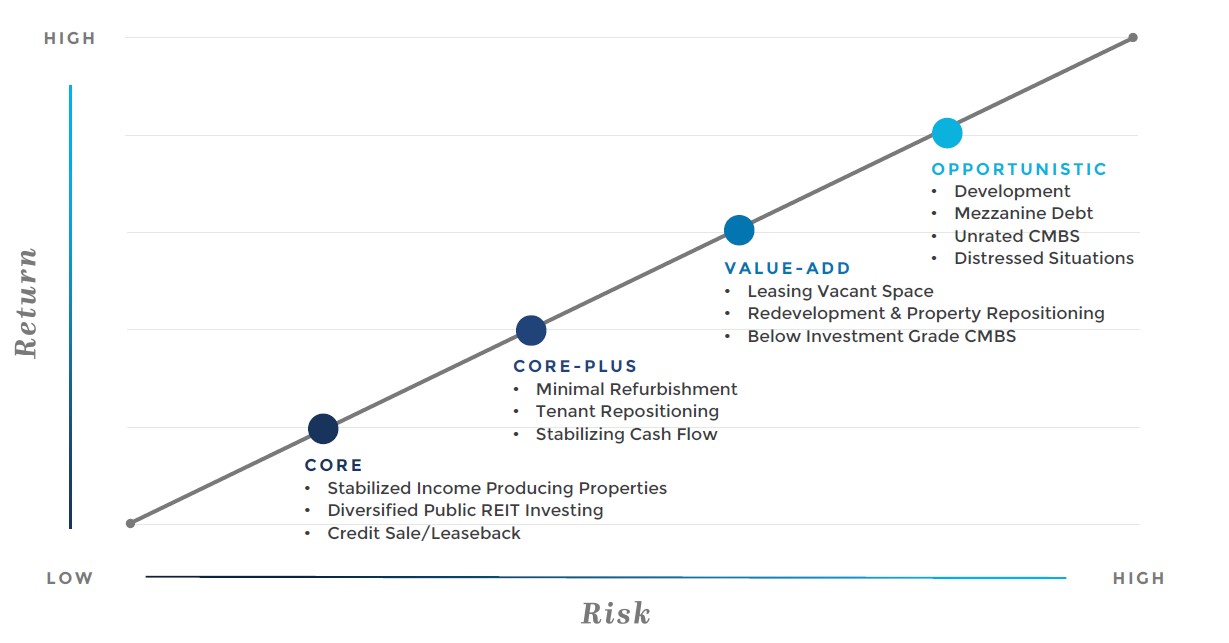
1 Source: https://www.realvantage.co/insights/investing-in-real-estate-know-your-spectrums-first/
2 There can be no assurance that these objectives will be achieved.
We don’t just offer advice; we architect solutions. Explore our real-world case studies to see how we navigate complex tax laws and market volatility to protect and grow our clients’ wealth.
Diversifying Concentrated Stock Positions for Risk Reduction and Income Planning