
Diversifying a 1031 Exchange
Strategic Transition to Passive, Institutional-Grade Real Estate

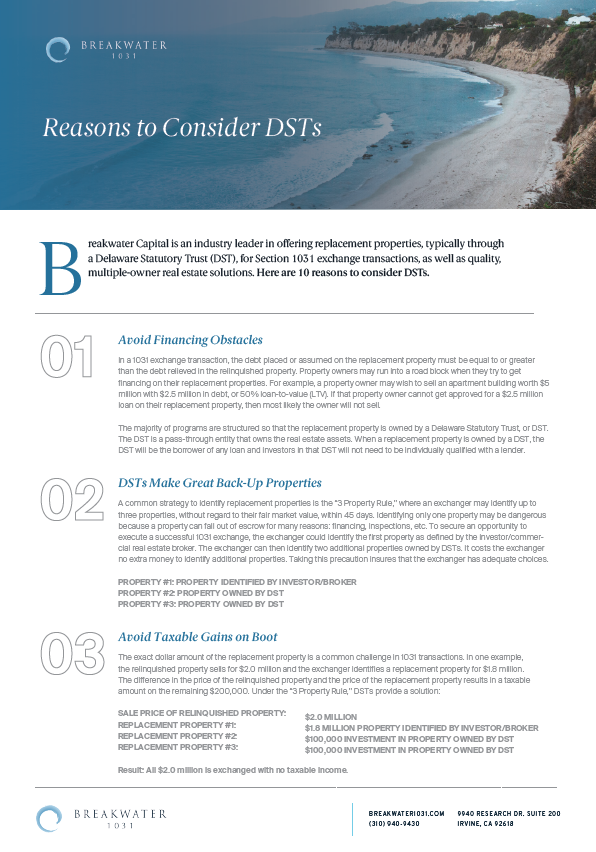
While some investors prefer to identify replacement property through traditional, local real estate channels, others seek broader diversification, geographic reach, and a shift from active management to passive ownership. For those investors, Delaware Statutory Trusts (DSTs) offer an effective solution.
DSTs allow investors to acquire fractional interests in institutional-quality, professionally managed, income-producing real estate, providing diversification and reduced operational responsibility—making them an attractive option for those seeking long-term stability and simplicity.

When you invest l031 money into a DST, you take on partial ownership of the equity and debt. These sample clients’ investments provide tangible examples of what your DST could potentially look like.

Sold Beach House.
Exchanged Into DST (10% Owner)
Equity
$800,000
Debt
$1,200,000
Debt
$1,200,000


Sold Industrial Building.
Exchanged Into DST (5% Owner)
Equity
$1,200,000
Debt
$1,800,000
Debt
$3,000,000
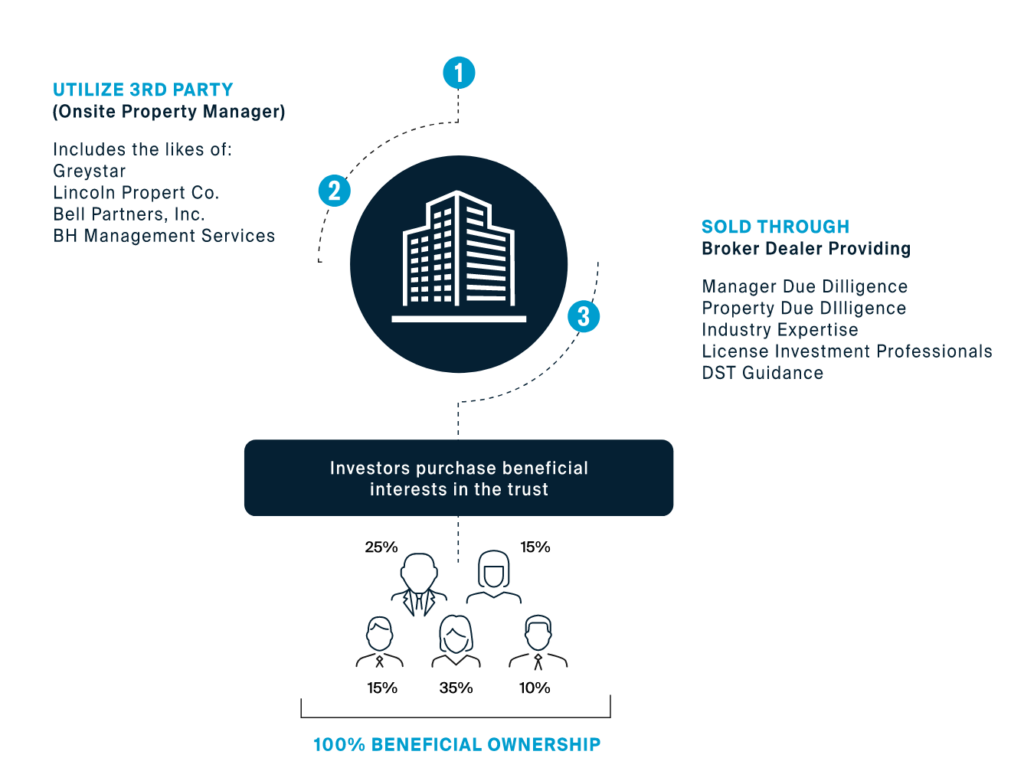
For many exchangers, DSTs offer a more efficient alternative to acquiring and managing a single, wholly owned property. Instead of sourcing, financing, and operating a property themselves, investors can:
By eliminating sourcing risk, financing uncertainty, and management responsibilities, DSTs allow investors to focus on tax deferral, diversification, and execution certainty.
DSTs were created specifically to serve investors who prioritize passive income, capital preservation, diversification, and tax deferral without the operational burden of direct ownership.
They all have specific characteristics associated with them:

Most DSTs employ an LTV between 0% to 50%. This is always long-term fixed financing, no adjustable rates

The property must meet certain occupancy thresholds before available to investors.

Sponsors cannot employ high-speculation tactics like ground-up developments or deep value-adds.

Since DSTs cannot deploy significant capital expenditures to create value, most properties are either new/recent builds.

DSTs cannot ask investors for more money at any point in time. Therefore, each DST begins with ample reserves to account for any unforeseen circumstances or shortfalls in operating income.
The DST is the single owner and agile decision maker on behalf of investors.
DSTs allow investors to acquire partial ownership in properties that otherwise would be out-of-reach.
Loans are nonrecourse to the investor. The DST is the sole borrower.
Investors can divide their investment among multiple DSTs, which may provide for a more diversified real estate portfolio across geography and property types.
The DST structure allows the investor to continue to exchange real properties over and over again until the investor’s death.
Can close in as little as 3-5 business days with no interaction with a bank and possibly continue your cash flow uninterrupted as soon as the following month.
A DST can act as a prudent backup if a direct property acquisition falls through.
As long as there is available equity, exchangers can make reservations in a given DST until their sale closes. Should they change their mind or if their sale doesn’t close, the investor is not obligated to the sponsor, nor will they be charged any penalties.
Some investors have excess proceeds in a 1031 exchange. Investing those funds into a DST can help avoid taxable boot.
Not for those seeking outsized returns in a short amount of time or are pursuing aggressive growth strategies (developing or deep value adds).
Not for investors who need 100% control.
Interests of a DST should be considered illiquid just like any other real estate, especially if you invest via a 1031 exchange.

Diversification is one of the most effective ways to manage risk in real estate investing. Rather than concentrating capital in a single property, investors can reduce exposure by allocating across multiple assets with varying risk profiles.
DSTs allow diversification across:
Diversifying by sponsor is especially important, as it helps avoid reliance on a single management team or operating strategy. When structured thoughtfully, a diversified DST portfolio can help mitigate risks associated with tenant concentration, market cycles, and asset-specific performance.

The DST sponsor leverages their strong lender relationships to attempt to obtain financing terms investors would most likely not be able to obtain on their own.
The DST Assigns The Benefits Of The Debt But Retains The Obligations. The Debt Is Non–Recourse To The Investor. The Investor Does Not Need To Qualify For The Debt Personally.
Investors fulfill their debt requirements without the headache associated with qualifying for and being liable for the debt obligations.
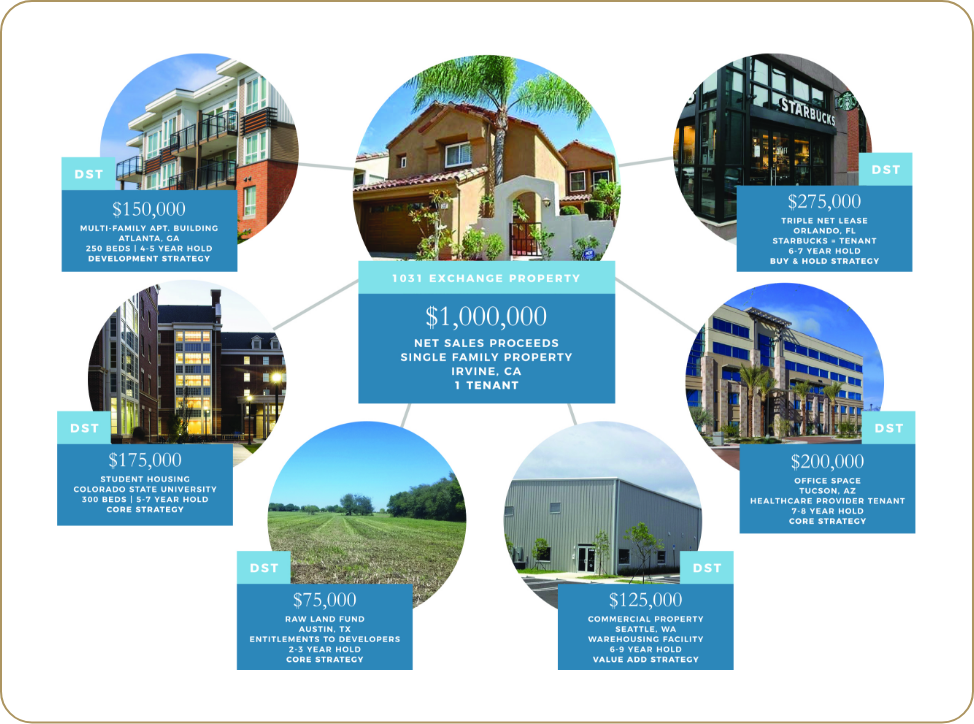
One of the most compelling benefits of utilizing Delaware Statutory Trusts within a 1031 exchange is the ability to meaningfully diversify. In the example below, an investor transitions from a single-family rental into multiple DST offerings.
While the investor maintains exposure to real estate as an asset class, the risk profile becomes more balanced through diversification across multiple properties and tenants, varied geographic markets, and a mix of asset types and sponsors. This approach can reduce concentration risk while providing broader exposure to institutional-quality real estate.
We don’t just offer advice; we architect solutions. Explore our real-world case studies to see how we navigate complex tax laws and market volatility to protect and grow our clients’ wealth.
Strategic Transition to Passive, Institutional-Grade Real Estate