We work in a broker capacity and represent the various investment companies we choose to work with. We are not contractually obliged to work with any specific sponsor, the only reason we would recommend them to an investor is because we believe they are very good at what they do and have proven to us to be effective over the years working with them.
An investor will never have to deal with a bank at any point in time. The sponsor will structure the debt before a deal is available to investors and typically get much better rates than an individual investor due to the size of the offering. The debt to investors is defined as non-recourse, meaning that you are not personally responsible for the debt, the DST is. The investor assumes whatever debt the DST has already put in place. For example, if the DST has a 50% LTV and an investor allocates $100k, they will also receive another $100k in debt for an overall position of $200k.
A typical DST will structure the debt for 10 years with an initial 5-year interest only period, followed by another 5-year amortization period. The reasoning behind this is to attempt to maximize the cash flow and sell the property close to the 5-year mark.
A sponsor is the company that purchases the property, structures the debt, is responsible for management of every facet of the property from A to Z, then seeks to sell it within a certain period of time. Most will specialize within a given asset class (i.e. Multi-Family, Commercial, Industrial, etc.) and have similar offerings available on a regular basis.
While the trust owns the property, each investor is treated as a beneficial owner by the IRS. For instance, if a property is worth $100M (assuming no debt) and an investor allocates $1M, they would beneficially own 1% of the property. They are entitled to 1% of any income, appreciation and depreciation. It doesn’t matter whether they are the first or last investor, or the amount they invested, everyone is treated the same.
The sponsor is required to provide a tax statement to each investor every year. It will state how much income they received and how much depreciation they can use to offset said income. If an investor is working with a CPA, they can simply turn over this form to them.
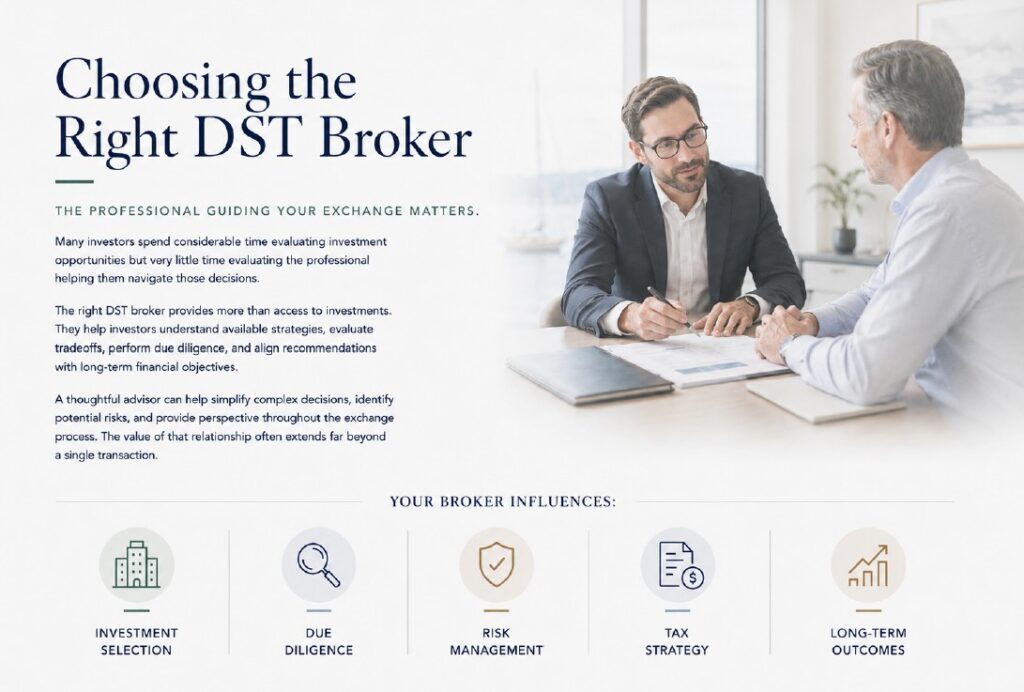
Many investors spend considerable time evaluating investment opportunities but very little time evaluating the professional helping them navigate those decisions.
The right DST broker provides more than access to investments. They help investors understand available strategies, evaluate tradeoffs, perform due diligence, and align recommendations with long-term financial objectives.
A thoughtful advisor can help simplify complex decisions, identify potential risks, and provide perspective throughout the exchange process. The value of that relationship often extends far beyond a single transaction.


Multifamily real estate includes apartment communities and other residential housing properties that generate income through rental payments from residents.
Unlike many commercial real estate sectors that rely on a single tenant or long-term lease agreement, multifamily properties derive income from numerous residents across hundreds of individual lease agreements. This creates a different investment dynamic—one that is influenced by occupancy levels, rental demand, local market conditions, and operational execution.


Triple Net (NNN) lease investments involve purchasing commercial properties that are leased to a single tenant under a long-term lease where the tenant is responsible for paying property taxes, insurance, and maintenance costs—on top of base rent.
This structure provides investors with predictable income, reduced expenses, and fewer management responsibilities.
Every real estate investment involves a series of trade-offs.
Some strategies prioritize stable income and predictability. Others seek greater appreciation potential and long-term growth. Some rely on debt to amplify returns, while others focus on preserving capital through lower leverage and reduced risk.
For investors completing a 1031 exchange, the decision often extends beyond simply selecting a property. The structure of the investment, the source of income, the use of leverage, and the underlying business plan can all influence both performance and risk.


Every real estate investment involves a series of trade-offs.
Some strategies prioritize stable income and predictability. Others seek greater appreciation potential and long-term growth. Some rely on debt to amplify returns, while others focus on preserving capital through lower leverage and reduced risk.
For investors completing a 1031 exchange, the decision often extends beyond simply selecting a property. The structure of the investment, the source of income, the use of leverage, and the underlying business plan can all influence both performance and risk.


Every real estate investment involves a series of trade-offs.
Some strategies prioritize stable income and predictability. Others seek greater appreciation potential and long-term growth. Some rely on debt to amplify returns, while others focus on preserving capital through lower leverage and reduced risk.
For investors completing a 1031 exchange, the decision often extends beyond simply selecting a property. The structure of the investment, the source of income, the use of leverage, and the underlying business plan can all influence both performance and risk.


Alternative investments can play an important role in a well-diversified portfolio by providing access to asset classes that often behave differently than publicly traded markets.
While every investment carries risk, alternatives may offer unique opportunities for income generation, diversification, tax efficiency, inflation protection, and long-term growth. When thoughtfully integrated into an overall strategy, they can help investors pursue financial objectives that may be difficult to achieve through traditional investments alone.